What Is Coworking, and Why Is the Term Used for So Many Different Solutions?
Coworking” is a term most people are familiar with, yet it is used to describe a wide variety of workplace solutions. So what does it actually mean? In this article, we’ll clarify the concept, explore its origins, and explain why it has become increasingly difficult to define in practice.

Written by
Silje F. SundtLast published
One Term, Many Solutions
“Coworking” is a term used so broadly today that it has almost lost its meaning. Some people associate it with open-plan workspaces and shared areas, while others think of fully serviced business centres with a high level of support and amenities. As a result, many people are unsure what the term actually means and what they are getting.
Coworking is an umbrella term for office solutions where multiple businesses share facilities, infrastructure, and services, often on flexible terms.
The terms coworking, flexible office, office hotel, serviced office, and managed office are often used interchangeably. While they overlap in meaning, they do not describe exactly the same thing. What they do share is a common direction: a new approach to the workplace, where flexibility, service, and user experience are more important than the office space itself.
Where Does the Term Coworking Come From?
Coworking does not have a single, clear origin. As early as the 1990s, communities began to emerge that laid the foundation for what would later become coworking. Hacker spaces such as c-base in Berlin brought together developers and creative professionals in open, shared work environments where knowledge, infrastructure, and ideas were exchanged.
Shortly before the turn of the millennium, the term coworking was used to describe a collaborative way of working, where people worked side by side without belonging to the same organization. Over time, the concept became associated with values such as openness, collaboration, and community, not least through what became known as The Coworking Manifesto. This helped define coworking as more than just a physical space. It was about collaboration, sharing, and a more flexible and open approach to work, inspired in part by open-source communities.
The modern coworking concept emerged a few years later. In 2005, what is widely regarded as the first coworking space opened in San Francisco. The idea was to combine the freedom of working independently with the community and structure of an office, without the rigidity of a traditional workplace, but with the value that comes from working alongside others.
How Coworking Evolved into Today’s Flexible Office Solutions
Today, the term itself is less important than the type of solution it actually represents.
In its early days, coworking was particularly relevant for entrepreneurs, freelancers, and small businesses. They needed low-cost, flexible workplaces that provided access to a network and a professional community without the commitment of long-term leases.
The growth of coworking was driven by several parallel developments. Digitalisation made it possible to work from virtually anywhere, while new companies began scaling faster, often with fewer resources and greater ambitions. Markets became global from the outset, and the need for flexibility increased.
Over time, the model evolved and scaled. New providers combined flexibility with a more structured service offering, bringing together private offices, meeting facilities, workplace services, technology, and day-to-day operations in a single solution. Coworking was no longer just about shared desks, it became an entirely new way of delivering office space.
From Space to Service: A New Way of Thinking About the Office
Traditionally, office space has been treated as a product: you lease the space and manage furniture, IT, operations, and services separately. The newer models turn this approach on its head. The value shifts from square footage to everything that comes with it: service, experience, technology, and flexibility.
An office is no longer just something you rent. It is something you use and expect to work seamlessly from day one.
What Does Coworking Mean Today?
The pandemic accelerated a shift that was already underway. Almost overnight, digital collaboration became the norm, making it possible to work effectively without being physically together.
This also changed expectations. Employees experienced greater flexibility, while employers discovered that productivity is not necessarily tied to physical presence. The office did not disappear, but its role changed.
Today, the office is used more for collaboration, culture, and relationship-building, and less for individual work. Office usage has also become less predictable throughout the week than it was in the past.
For businesses, this raises new questions. How much space do we actually need? When is it being used? And how do we plan for needs that will continue to evolve over time?
When requirements become harder to predict, long-term leases are also more difficult to justify. As a result, flexible office solutions have evolved from being an alternative option to becoming an important part of how many organizations structure their workplace strategy today.
Useful for Larger Organizations Too
Where coworking was once primarily associated with small businesses, today it has become part of how larger organizations structure their workplace strategy.
For many companies, it is about managing a more unpredictable working environment. Business needs change more quickly, and office usage varies more than it did in the past.
By combining traditional office leases with flexible workspace solutions, organizations can adjust capacity, reduce risk, and build a more dynamic portfolio of workplaces. This allows them to scale up or down, test new locations, and adapt to how the office is actually being used.
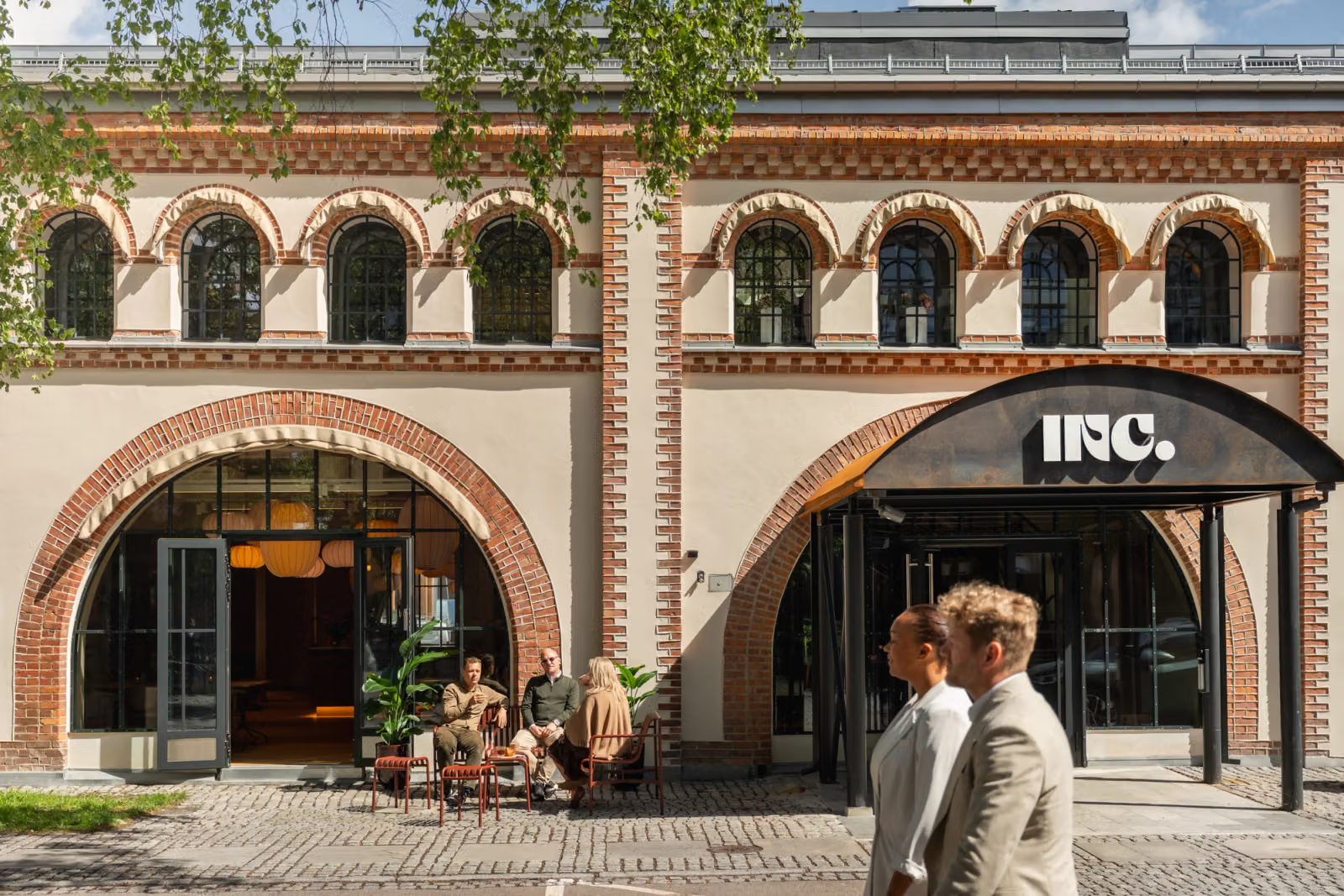
What Coworking Means in Practice at INC.
Coworking is still used as an umbrella term, but it no longer refers to one clearly defined solution. In practice, it has come to mean flexible office solutions designed around how businesses actually work.
That is exactly what we do at INC. We create flexible workplaces and meeting spaces based on how people work today, with a focus on flexibility, service, and experiences that add value to everyday working life.